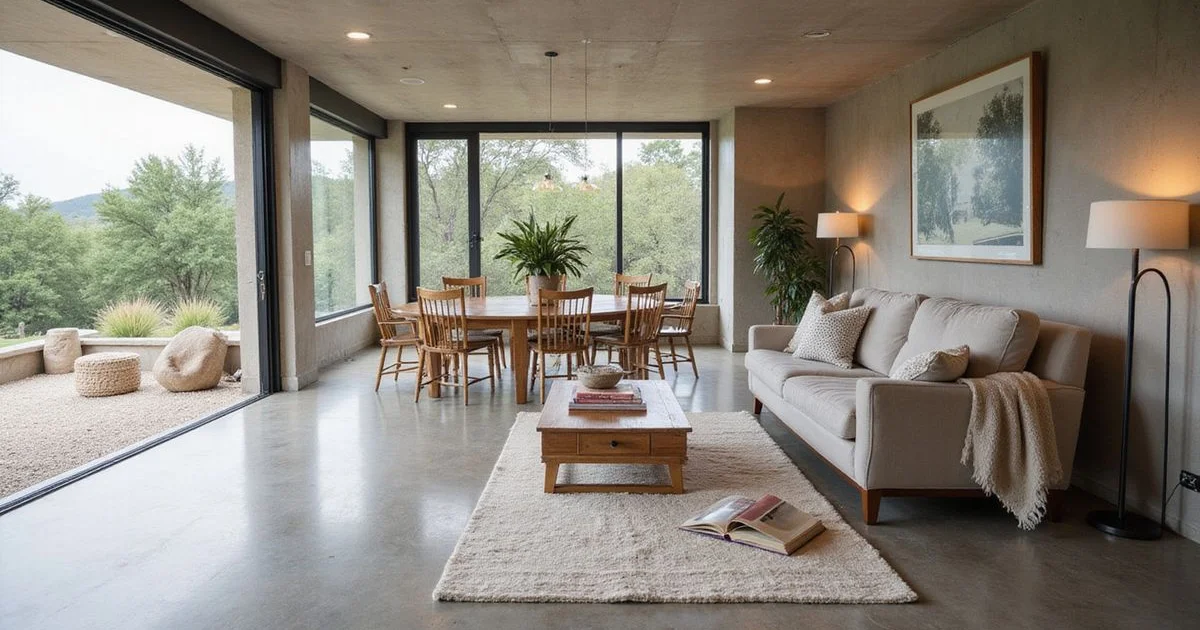
An honest balance sheet
Polished concrete gets written about enthusiastically, usually by people selling it. This page tries to be the version we would give a friend: what is genuinely good about it, what the real drawbacks are, and when to choose something else. The underlying process is described on our polished concrete page.
The advantages
There is no coating to fail. This is the big one. Mechanical polishing refines and hardens the slab itself, so nothing can peel, bubble, or delaminate. The failure mode is gradual dulling, which is recoverable.
Very low routine maintenance. Dust mopping and neutral-pH damp cleaning. No waxing, no stripping, no annual recoat. Over a decade the maintenance burden is genuinely small compared with most floor types.
It handles traffic well. Densification hardens the surface, which is why the same system appears in warehouses, retail floors, and busy family homes.
It works with underfloor heating. Concrete has real thermal mass, so where radiant heat is installed the floor holds and releases warmth efficiently.
It is the floor you already own. There is no new material to manufacture, ship, and eventually dispose of. The slab is already there.
It suits Austin’s climate and dust. A hard, sealed-tight surface that dust mops clean beats carpet in a region where fine grit gets tracked in most of the year.
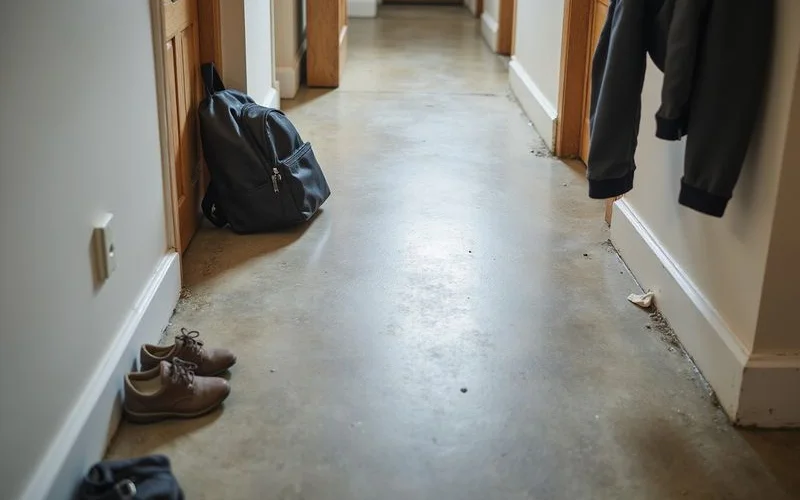
The drawbacks
It is hard. Dropped glasses break. Standing for long periods is less comfortable than on timber or vinyl. Anti-fatigue matting in a kitchen work zone is a reasonable addition rather than an admission of failure.
It is sensitive to acids. Wine, citrus, tomato, and some cleaning products etch the surface. Etching is not a stain you can clean off; it is a chemical change that needs re-polishing. Prompt cleanup prevents nearly all of it.
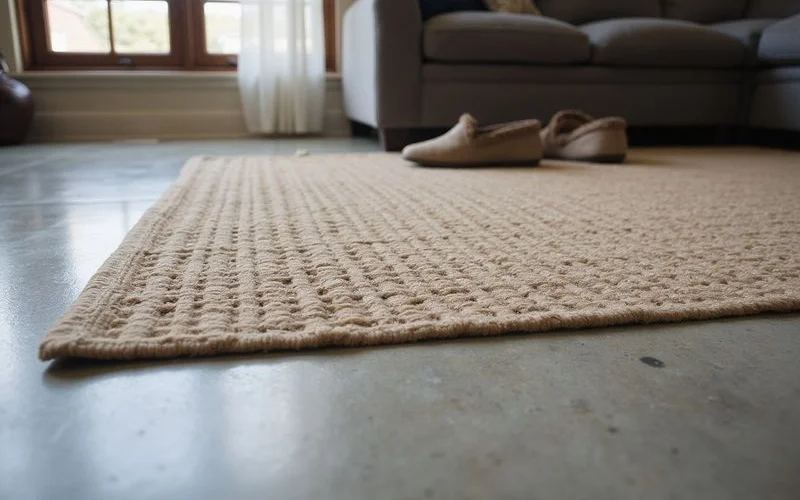
Sound carries. A large open room with hard floors is acoustically live. Rugs, soft furnishings, and curtains are part of the design rather than optional extras.
The result depends on the slab. Unlike a manufactured floor, you cannot order the exact appearance. Colour variation, aggregate distribution, and repair history come with the concrete you have. Our slab suitability guide covers the assessment.
Repairs stay visible. Filled cracks, trench lines, and patches read as part of the floor. Many owners like that; some do not.
It can feel cool. Pleasant for most of an Austin year, less so on a January morning in a bedroom without radiant heat.
Where it fits, room by room
| Space | Suitability | Note |
|---|---|---|
| Living and dining | Strong | Rugs soften acoustics and comfort |
| Kitchen | Strong, with care | Wipe acidic spills promptly |
| Entry and hallway | Excellent | Hard-wearing, dust mops clean |
| Bedrooms | Mixed | Comfort and warmth are the trade-off |
| Bathrooms | Case by case | Traction when wet needs discussion |
| Garage | Usually not | A coating generally suits better |
| Retail and office | Excellent | Widely used for exactly these reasons |
| Warehouse | Excellent | With densification and joint filling |
The question that actually decides it
Not “is polished concrete good?” but “is this slab, in this room, for these people, the right application?” Those are different questions, and only the second one has a useful answer.
When another option may be appropriate
If the slab is heavily damaged or too inconsistent to produce a floor you would enjoy, a polishable overlay delivers uniformity instead. If the space needs chemical resistance or a seamless coved surface, epoxy is the better fit. And if comfort underfoot genuinely matters more than durability in a particular room, timber or a resilient floor is the honest recommendation — we would rather tell you that than sell you a floor you regret in a bedroom.
Cost of ownership, not just installation
Installation price is the number people compare. Ownership cost is the number that matters over a decade, and polished concrete sits unusually well on that measure.
There is no wear layer to replace, no coating to recoat, and no stripping and resealing cycle. Running costs are cleaning consumables and, in busier settings, occasional burnishing. Damage is repaired locally rather than by replacing a section, and the repair blends reasonably because you are re-polishing the same material.
Set against that: installation cost varies enormously depending on what has to happen before polishing starts. On a bare, sound slab it is competitive with mid-range flooring. On a slab needing tile removal, adhesive grinding, and substantial repair, the preparation can exceed the polishing. Our cost guide breaks down which factors apply to your situation.
The honest summary: polished concrete is rarely the cheapest floor to install and very often the cheapest to own.
Questions to ask yourself before deciding
- Who lives here? Small children, elderly family members, and dogs each change the calculation differently.
- How much natural light does the room get? Strong directional light makes a glossy floor beautiful and unforgiving in equal measure.
- Will you actually dust mop? Be honest. The answer should drive your sheen choice.
- Do you want the floor to be a feature or a background? Exposure and sheen follow from that.
- How long are you staying? A ten-year horizon justifies more preparation than a two-year one.
- What is the slab actually like? Everything above is theoretical until someone grinds a test area.
Getting a suitability read on your own floor
Send floor area, how the room is used, and slab photos. What comes back is an assessment of your situation rather than a general endorsement — including, when it applies, the recommendation that polished concrete is not what that room needs.