A schedule beats good intentions
We often hear facility managers joke that their newly installed commercial polished concrete is a zero-upkeep surface.
That misconception is exactly how a premium floor turns dull and patchy within twelve months. The sheen comes from the mechanical polishing process, but preserving it requires a strict commercial polished concrete maintenance routine.
Our team hands this exact schedule over at the completion of every single project.
Let’s look at the data behind proper floor care, the necessary daily tasks, and how to write these standards directly into vendor agreements.
Daily
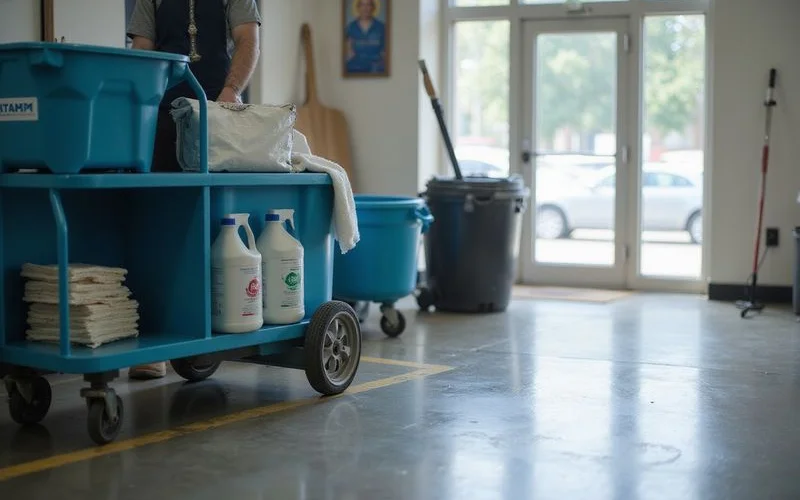
We tell our clients that daily dust mopping is the single highest-value maintenance task for polished concrete. Grit acts like sandpaper under heavy foot traffic. Constant abrasion destroys the floor’s Dynamic Coefficient of Friction, or DCOF. The ANSI A326.3 national standard requires a DCOF of 0.42 or higher for interior wet spaces in the US, and ground-in dirt drops your floor below that safety baseline fast.
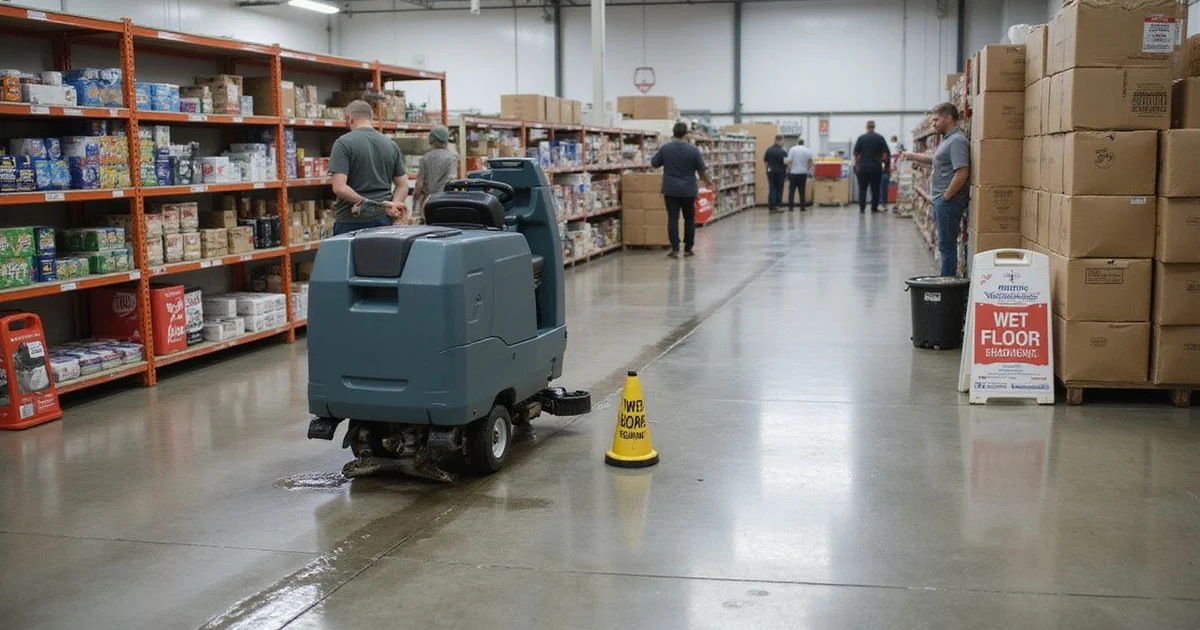
Our preferred method for large spaces is using an auto scrubber. Machine settings matter just as much as cleaning frequency. You must use a clean, non-abrasive pad with the equipment’s down pressure set below 50 pounds. Excessive pressure will micro-scratch the surface and ruin the finish.
We highly recommend autonomous floor scrubbers if your facility exceeds 50,000 square feet. Recent 2026 data shows that robotic units running overnight routes yield a full return on investment in 9 to 18 months through labor savings alone.
- Check entry matting. Most dirt arrives through the front doors. Displaced or saturated mats fail to trap this debris.
- Recover solution properly. Your auto scrubber must lift the dirty water entirely. Leaving contaminated water to dry just redistributes the soil.
- Address spills immediately. Acidic liquids will etch the surface permanently. Oil stains penetrate quickly and cannot be reversed by simple mopping.
Weekly
We require a full-floor clean every week using a strict neutral-pH product. This deep clean must hit the lower-traffic zones, edges, and corners that the daily scrubber route misses. The chemical choice here is absolutely critical for the lifespan of the floor.
Our technicians specify products with a pH between 7.0 and 8.0 to prevent chemical etching. Brands like Prosoco DailyKlean, which holds an EPA Safer Choice certification, or Ameripolish Rejuvenating Cleaner are excellent choices. These specific formulas deposit trace amounts of silicate densifier back into the concrete during the wash.
- Inspect traffic lanes. Look for early dulling at main intersections. Catching this early means a quick pass with a burnisher will restore the clarity.
- Check pads and equipment. A worn pad will severely scratch the floor. You should rotate these pads on a set schedule instead of waiting for visible wear.
Monthly to quarterly
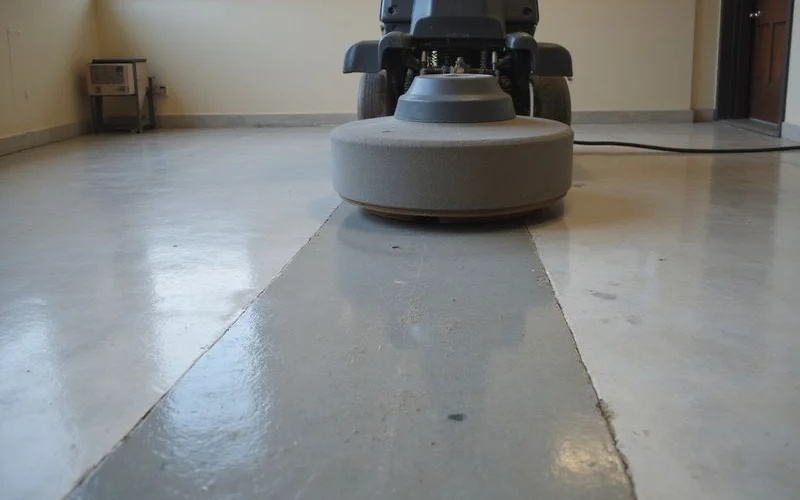
We rely on high-speed burnishing to restore clarity and pop the shine in worn traffic lanes. A propane or electric burnisher running at 1,500 to 2,000 RPM creates enough friction to melt the microscopic surface resin. You must pair this machine with a diamond-impregnated pad, typically in the 1500 to 3000 grit range, depending on the desired gloss level.
Our recommended frequency depends entirely on your foot traffic and environment. Busy retail environments need more attention than a standard office lobby.
| Environment | Typical burnishing interval |
|---|---|
| Busy retail | Monthly |
| Restaurant front of house | Monthly to six-weekly |
| Office and lobby | Quarterly |
| Warehouse traffic lanes | Quarterly, or as wear dictates |
| Low-traffic storage | As needed |
We also mandate a deep clean of edges and corners every single month. Dirt accumulates heavily where the baseboards meet the floor, requiring manual scrubbing to prevent permanent staining.
Annually, or as conditions indicate
Our team always assesses the floor’s absorption rate at the one-year mark. You can test this by pouring a small amount of water on a high-traffic area. If the water darkens the concrete within two minutes, the surface needs re-densification to prevent future stains.
We review the entire floor under a low-angle raking light to spot micro-scratches. This specific lighting technique reveals lane wear and etching far better than an overhead inspection from standing height.
Our experience shows that localized re-polishing is incredibly cost-effective when wear is significant. Current 2026 industry averages indicate that re-polishing specific traffic lanes costs roughly $1 to $3 per square foot, which is a fraction of the cost to replace commercial flooring. The maintenance overhead drops significantly when you treat minor issues early.
Products: what to use and what to keep off the floor
We see perfectly good floors ruined by well-meaning janitorial staff using the wrong bucket of chemicals. Facility floor maintenance requires strict control over what touches the concrete.
| Use | Avoid |
|---|---|
| Neutral-pH concrete cleaner (pH 7-8) | Acidic cleaners, citrus formulas, and vinegar |
| Clean water and clean recovery tanks | High-alkaline industrial degreasers |
| Non-abrasive burnishing pads (1500+ grit) | Aggressive scouring pads or wire brushes |
| Manufacturer-recommended densifiers | Wax, acrylic floor polish, or “restorers” |
| Proper entry matting | Anything that leaves a soapy film |
Tell your cleaning contractor this specifically:
No wax, no floor polish, no shine restorer. Those products leave a film that clouds a polished floor, attracts soil, and eventually has to be removed professionally. The sheen comes from the concrete itself.
Writing it into a cleaning contract
We strongly advise putting this exact polished concrete cleaning schedule into the vendor contract if your facility outsources the daily work. You cannot assume a general commercial cleaner understands the chemistry of densified concrete. A solid contract specifies the exact chemical brands, the required neutral pH range, and the use of soft white pads for daily auto scrubbing.
Our contracts mandate that the vendor reports early dulling immediately, rather than trying to hide it under an unauthorized acrylic wax. A simple annual walkthrough with your flooring contractor is the best preventative measure you can take. This twenty-minute inspection catches the minor dulling issues that are cheap to fix with a quick burnish.
The mistakes we are called in to fix
We fix a lot of expensive mistakes, and they almost always stem from poor daily habits. A lapsed routine causes severe damage over time.
- Wrong chemical, used consistently. Applying an acidic bathroom cleaner or a harsh alkaline degreaser across a retail floor will destroy the finish within a single season. The floor looks worn, but the surface is actually etched and requires mechanical grinding to fix.
- Auto scrubber recovering badly. The squeegee blades on a scrubber should be rotated or replaced every 90 days. If the vacuum is weak or the blade is torn, the machine just spreads dirty, abrasive water across the facility.
- Pads left too long. A contaminated pad acts like sandpaper. When a pad picks up metal shavings or hard sand, it drags those particles across the entire floor.
- A shine restorer applied by a well-meaning contractor. This is the most frustrating issue contractors encounter. Someone notices the floor looks tired and applies a cheap acrylic product designed for VCT flooring. The worker creates a cloudy film that requires chemical stripping before anyone can even assess the real damage.
- Matting removed or undersized. Entry matting stops a massive amount of exterior dirt from entering a building. It is the cheapest maintenance item available, yet it is often the first thing discarded during a lobby redesign.
Budgeting for floor maintenance
We always frame facility budgets by viewing polished concrete as a low-cost operational expense rather than a recurring capital replacement. A properly densified floor lasts well over twenty years before needing a full restoration.
Labor accounts for 60 to 80 percent of any facility cleaning budget. Our clients reduce this burden by investing in autonomous scrubbers. This technology shifts repetitive labor hours to higher-value tasks like edge cleaning and immediate spill response.
Capital costs arrive far less often than with traditional tile or coated floors. You typically only need to budget for localized re-polishing in heavy traffic lanes. Budgeting for periodic assessments and minor burnishing reflects reality far better than planning for a total floor replacement.
How this differs from a home floor
We remind residential clients that their floors experience a tiny fraction of the abrasion seen in a commercial space. A home floor primarily needs dust mopping, a damp mop with clean water, and prompt spill cleanup. That basic routine is covered in our polished concrete maintenance guide. For a floor still being installed, the handover and return-to-use sequence sits in our commercial polishing project planning guide.
Our crew only recommends high-speed burnishing for residential spaces on a very rare, as-needed basis. Take a few photographs with a flashlight raking horizontally across the surface if your commercial floor has already dulled and you are unsure of the next step.
We will review the scratching and tell you exactly what the floor needs, even if the answer is just a better daily cleaning routine.