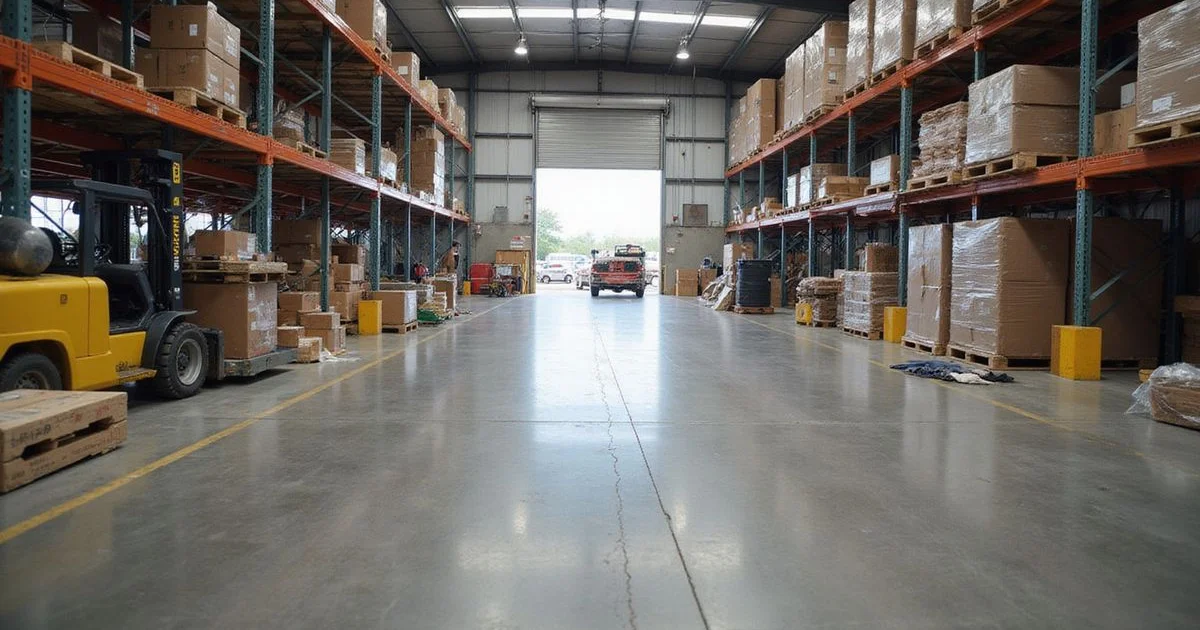
Why distribution floors get polished
Warehouse operators do not choose polished concrete for its looks. They choose it because a densified, polished slab produces less dust than bare concrete, reflects overhead light so the space needs less of it, cleans faster with an auto-scrubber, and does not have a coating that can peel and create a bigger problem.
The specification is different from a retail or residential floor in almost every respect, which is why it sits as its own conversation within our commercial polished concrete work.
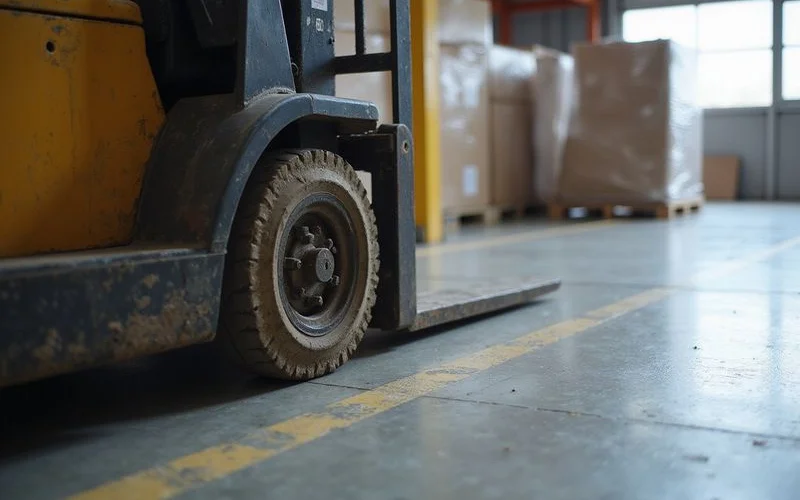
What matters on an industrial floor
Densification above appearance. The silicate densifier is doing structural work here, hardening the surface so it resists abrasion from wheels, pallets, and dragged loads. On a warehouse floor we would rather see a properly densified fine exposure than a highly polished cream finish.
Joint condition. This is where warehouse floors fail. Hard polyurethane forklift wheels hammer the unsupported edges of control joints, and once an edge spalls it accelerates — every subsequent wheel hits a step instead of a flat surface.
Flatness in pick aisles. Narrow-aisle and very-narrow-aisle operations have flatness requirements driven by mast height. Grinding improves local flatness but does not correct a slab’s overall profile, and we say so rather than implying otherwise.
Slab history. Old coatings, adhesive from previous racking layouts, oil staining from equipment, and repairs from rack-leg impacts all affect preparation scope.
Joint filling explained
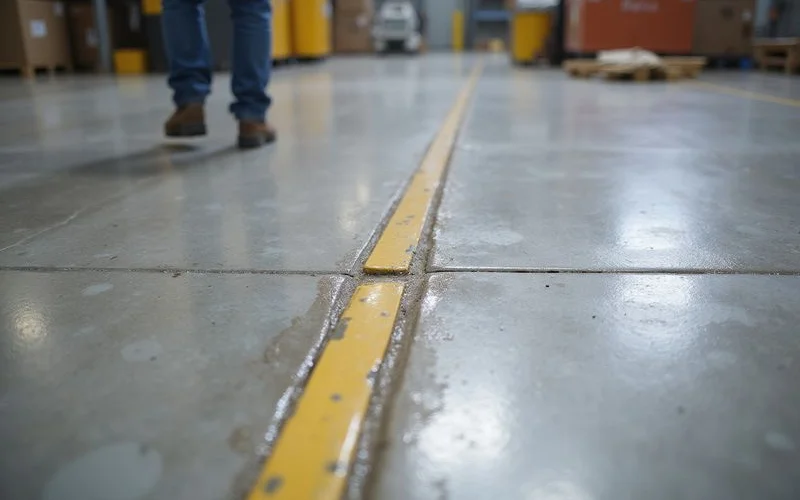
A semi-rigid polyurea joint filler is placed full-depth into the joint and shaved flush. Its purpose is mechanical: it supports the joint edges so a wheel rolls across rather than dropping into a gap and striking the far edge.
Two points that get confused:
- It is not a sealant. A flexible sealant keeps water out. A semi-rigid filler carries load. They are different products for different jobs.
- It does not stop the joint moving. The joint continues to open and close seasonally, and the filler may separate slightly on one side. That is expected behaviour, not a failure.
Specification for a warehouse floor
| Element | Typical warehouse approach |
|---|---|
| Aggregate exposure | Fine (salt-and-pepper) — durable, forgiving, consistent |
| Appearance level | Moderate; high gloss offers little operational benefit |
| Densifier | Specified and applied at the correct stage, product named |
| Joint treatment | Semi-rigid polyurea where wheel traffic crosses joints |
| Repairs | Rack-leg impact damage, spalls, and cracks addressed first |
| Protective treatment | Case by case; guard treatments help with oil staining |
| Maintenance | Auto-scrubber routine plus scheduled burnishing |
Where the money is actually saved
Lighting and cleaning. A polished floor reflects overhead light more efficiently, and an auto-scrubber covers a dense, smooth surface faster than a porous one. Those recur every month; the polishing is a one-off.
Scheduling around an operating facility
Very few distribution centres can stop. Our approach is zone-based: sequence around racking layouts and pick paths, work nights and weekends where the operation allows, and hand each zone back with a stated return-to-use time.
Practical constraints we plan around:
- Racking that cannot be moved, and the strip of floor beneath it
- Live pick faces that must stay accessible
- Inbound and outbound dock schedules
- Battery charging areas and other fixed equipment
- Fire lanes and marked walkways that must be reinstated
The broader phasing method is covered in commercial polishing project planning.
What to check before committing
A short due-diligence list for a facility manager evaluating polished concrete:
Joint condition survey. Walk the floor and note joints with spalled edges. Those need attention before or during polishing, and the count drives a meaningful part of the cost.
Rack-leg impact damage. Base plates and forklift strikes leave localised damage that gets repaired during preparation. Counting the affected locations avoids surprises.
Existing coatings or sealers. Anything previously applied must be mechanically removed, and old line marking is included in that.
Oil and fluid contamination. Charging areas, maintenance bays, and equipment parking positions often carry absorbed oil, which affects both grinding and densifier penetration.
Line marking plan. Decide before work starts whether fire lanes, aisles, and safety markings will be reinstated, how, and by whom. Marking onto a polished floor uses different products than marking onto bare concrete.
Maintenance capability. Confirm you have or can get an auto-scrubber, the right pads, and a neutral-pH cleaner. A polished warehouse floor without a scrubber routine will not stay looking right.
Realistic maintenance expectations
A warehouse floor carries more abuse in a month than a home floor does in a decade. Expect to run an auto-scrubber with the right pad and a neutral-pH cleaner, burnish traffic lanes on a schedule, and re-densify at intervals in the heaviest areas.
What you should not expect is a floor that never changes. Traffic lanes will read differently from storage areas over time. That is wear, not failure, and it is recoverable — which is exactly the advantage a mechanically polished floor has over a coating in this environment.
Send your floor area, traffic type, joint condition, and operating constraints. You will get a specification and a phasing approach back, not a rate per square foot applied to a number you gave over the phone.