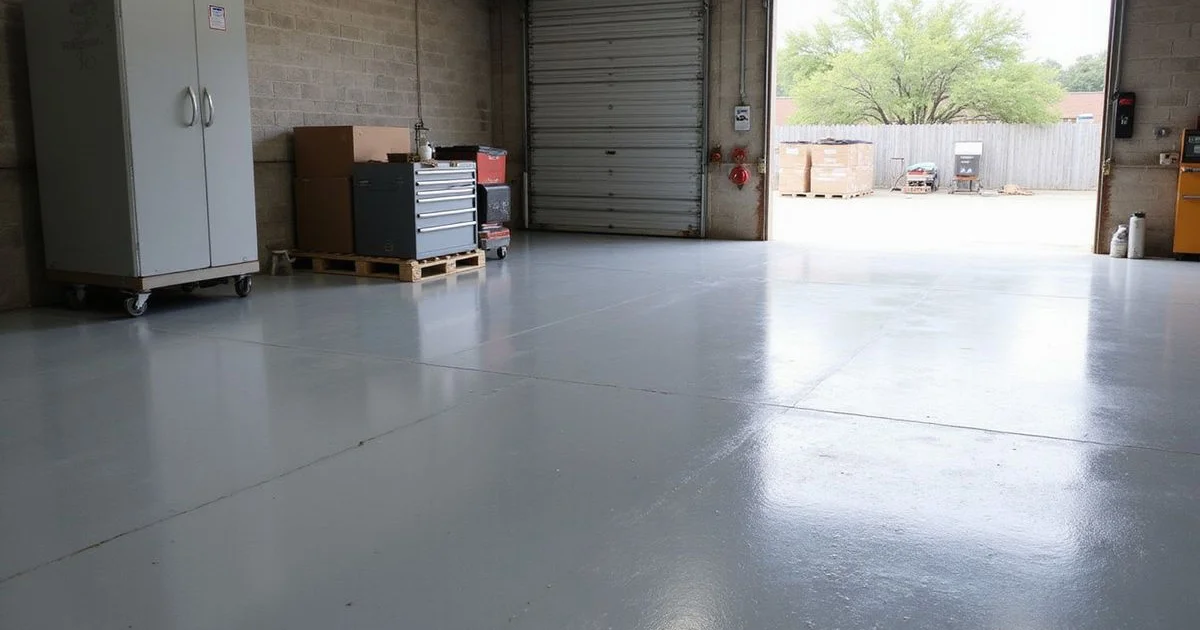
You know how every concrete coating project seems to start with a request for standard epoxy? As a professional service team installing commercial and residential floors, we notice a recurring theme when talking with facility managers and homeowners about concrete protection. Everyone asks for guidance on epoxy flooring uses and care, but very few people know what that specification actually means.
Our team sees this confusion every day, and it explains why some US installations last two decades while others fail in six months.
Let’s look at the data, what the materials are actually doing, and explore the practical steps for choosing and maintaining the right system.
What “epoxy flooring” actually covers
Epoxy flooring is a specialized coating system applied over mechanically prepared concrete. The finished surface creates a protective film bonded directly to the slab, rather than altering the concrete itself.
This fundamental difference from mechanical polishing explains why the two behave so differently over time. The term itself covers a massive range of products with vastly different lifespans. A thin, single-coat garage kit might measure just 3 to 10 mils thick, while industrial systems built with 100% solids and a urethane wear coat often exceed 125 mils.
These two extremes are both sold as “epoxy,” but they are not comparable in durability. Our epoxy flooring work always names the actual system and specific thickness rather than the broad category — the residential end of that range is covered in our guide to garage epoxy flake and polyaspartic coatings. Knowing your exact target thickness, measured in thousandths of an inch or mils, prevents you from overpaying for an under-performing product.
Common thickness categories based on 2026 industry standards include:
- Thin-Coat Systems (3-10 mils): Best for light residential use and foot traffic.
- Self-Leveling Systems (20-40 mils): Ideal for medium commercial environments.
- Heavy-Duty Systems (125-250 mils): Designed for extreme industrial abuse and heavy forklifts.
How a system is built
Most commercial epoxy uses require a layered approach, where every chemical application performs a specific job. You cannot skip a layer without sacrificing the entire system’s integrity, which is why we build these surfaces from the bottom up to guarantee long-term performance.
Essential Coating Layers
- Primer: This layer bonds directly to the profiled concrete. If your slab fails the ASTM F2170 relative humidity test, you must use a specialized moisture-mitigating primer to trap vapor.
- Base coat: This acts as the body of the system. Installers tint this layer when a solid color is specified.
- Broadcast: Vinyl flake or quartz is scattered into the wet base. This adds texture, essential traction, and visual appeal.
- Topcoat: The final wear layer protects everything underneath. A polyaspartic or aliphatic urethane topcoat provides superior defense, often scoring twice as high on the Taber abrasion test compared to basic epoxy.
Dry film thickness dictates the final durability of these layers. A quote that fails to state the exact build thickness is simply a quote you cannot compare with another.
Where epoxy genuinely suits
Epoxy coatings perform best in controlled, high-traffic environments where chemical resistance and easy sanitation are top priorities. It is an industrial solution designed to solve specific operational problems, and we frequently specify these floors for facilities that face aggressive daily wear.
| Space | Why a coating fits |
|---|---|
| Residential garage | Resists fluids and hot tires; easy to sweep |
| Workshop | High impact resistance protects against dropped tools and heavy machinery |
| Commercial back-of-house | Meets 2026 FDA Food Code requirements for continuous, coved wall junctions |
| Plant and mechanical rooms | Non-porous surface blocks oil, coolants, and industrial chemicals |
| Wash-down areas | Sealed finish paired with aggressive textured traction prevents slips |
There are definitely places where this material is the wrong choice. General living spaces usually benefit from polished concrete, which offers a much better long-term maintenance story. Large, sun-exposed floors will also degrade quickly unless the system includes a premium UV-stable topcoat to prevent yellowing.
The limits worth understanding
Every resinous flooring system has hard chemical and physical boundaries that you cannot ignore. Understanding these exact epoxy floor limitations prevents catastrophic failures down the road, so our installation process revolves around mitigating these exact risks before mixing a single batch of resin.
The Four Major Coating Vulnerabilities
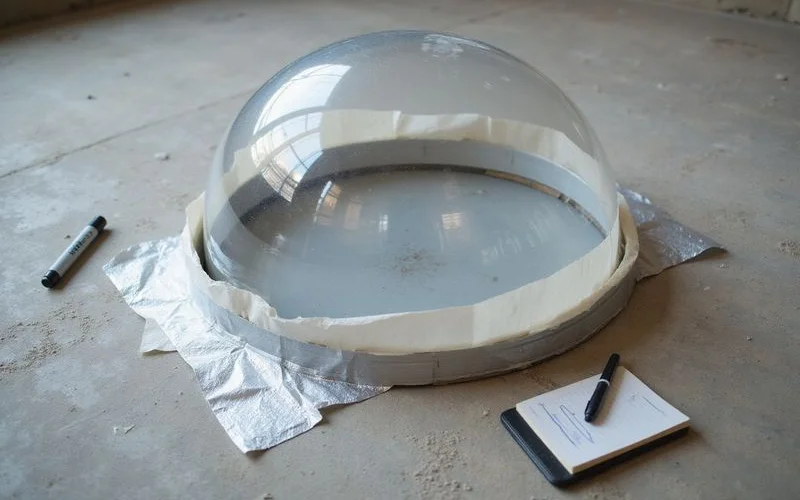
- Moisture: Vapor transmission through a slab will violently lift a coating. Slabs in high-humidity areas absorb and release significant groundwater. Testing is mandatory, as any vapor emission rate above 3 pounds per 1,000 square feet (via calcium chloride testing) usually requires a specialized barrier.
- Temperature: Products have strict application temperature windows and service limits. Hot tire pickup is a highly destructive phenomenon common with thin, single-coat garage kits. Summer asphalt can heat automotive tires beyond 130°F, and as that hot rubber cools on the garage floor, it aggressively grips and tears the coating right off the concrete.
- UV exposure: Standard bisphenol-A epoxy resins will amber and yellow rapidly in direct sunlight. If daylight reaches the floor, a UV-stable polyaspartic topcoat is a required specification, never an optional upsell.
- Preparation dependency: A high-performance coating is only as strong as its physical bond to the substrate. The International Concrete Repair Institute (ICRI) mandates a specific concrete surface profile, typically CSP 2 or 3, for proper adhesion. Poor mechanical profiling remains the leading cause of peeling across the US, and no expensive resin can compensate for a smooth, unprepared slab.
What we will not tell you
That an epoxy floor is permanent, indestructible, or maintenance-free. Every coating has a service life. Being told what shortens yours is more useful than being told it will never end.
Epoxy flooring uses and care
Knowing how to care for epoxy floor surfaces comes down to removing abrasive dirt and using the correct pH-neutral chemistry. Daily maintenance prevents microscopic scratches that permanently dull the protective topcoat, and we recommend a very specific, simple routine to maximize the lifespan of your investment.
- Routine: Sweep or dust mop daily to remove sharp grit, which acts like sandpaper against the resin. Wash the surface weekly using a pH-neutral solution like Simple Green Pro HD diluted in water.
- Avoid: Never use abrasive scouring pads, heavy solvents, or highly acidic liquids. Common household cleaners containing vinegar or citrus will slowly etch and degloss the urethane finish.
- Protect: Place specialized mats under vehicle parking positions if your coating is thin and vulnerable to hot tire pickup. You should also install rubber pads under the steel feet of heavy workshop equipment.
- Watch for: Monitor the floor for sudden bubbling, edge lifting, or isolated dull patches. These localized failures signal trapped moisture or chemical damage, and reporting these issues early keeps repair costs low.
Repair and eventual recoat
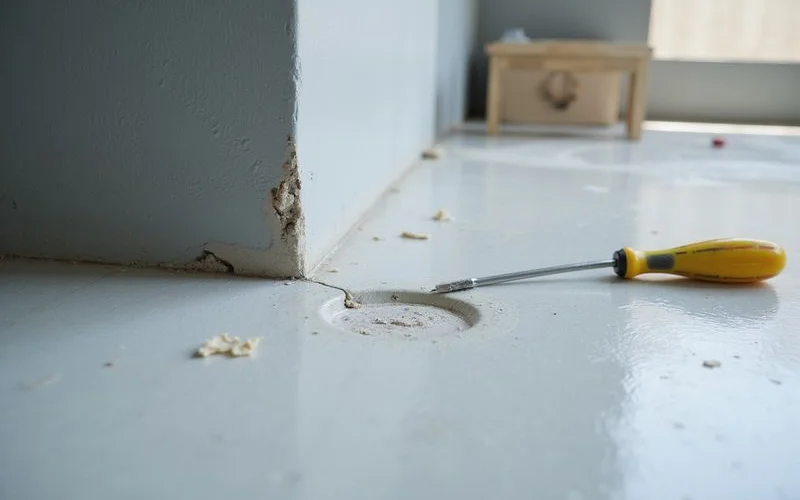
Even the strongest coatings eventually degrade and require professional refurbishment. The repair process involves mechanically abrading the damaged zone and applying fresh, compatible resin.
Our technicians find that blending a new patch invisibly is quite difficult, especially on solid color floors where the fresh boundary easily catches the light. Because of this, most commercial epoxy floors installed in the US boast a functional lifespan of 10 to 15 years before the topcoat wears thin and requires a full resurfacing.
When your floor reaches this end-of-life stage, you face two distinct paths:
- The Scuff-and-Recoat: If the existing system remains tightly bonded, installers rough up the surface with a 60-80 grit sanding screen and apply a fresh wear layer.
- The Complete Rebuild: This costly path requires aggressive mechanical removal. It becomes mandatory when the original bond fails or trapped moisture vapor destroys the primer layer.
Always confirm the structural integrity of your current bond with an experienced professional before finalizing a repair strategy.
How a proper epoxy quote is written
A trustworthy contractor writes a quote as a detailed technical specification, not a vague promise. Because the coating category covers such a massive range of chemical formulations, the written proposal must detail every single variable.
We insist on complete transparency because hiding the material thickness is the easiest way for a low bidder to cut corners. Here is exactly what a professional 2026 specification must include:
| Line | What it should say |
|---|---|
| Preparation method | Grinding or shot blasting, specifying the exact ICRI surface profile target |
| Moisture testing | The testing protocol used, and the exact remediation plan if vapor readings test high |
| Primer | Chemical product type, and confirmation of its moisture-mitigating properties |
| Base coat | The specific product name and the total number of applied coats |
| Broadcast | Choice of flake or quartz, coverage density percentage, and exact color blend |
| Topcoat | The chemical type, number of coats, and guaranteed UV stability rating |
| Film thickness | Target dry film thickness listed clearly in mils for the entire finished system |
| Cure times | Minimum waiting periods required before allowing foot traffic and heavy vehicle traffic |
| Repairs | Clear documentation stating whether crack filling and spall treatments are included or excluded |
A proposal missing the concrete preparation method and the topcoat chemistry is practically useless. You simply cannot compare a detailed, 40-mil layered system against a vague quote, regardless of how appealing the bottom-line numbers look side by side.
Signs an existing coating is failing
Early detection of a failing coating allows you to patch isolated damage before it spreads across the entire slab. It is incredibly valuable to recognize these physical warning signs if you are inheriting an older floor, and our inspection crews look for five specific indicators of systemic failure.
Common Warning Signs of Failure
- Edge lifting: This occurs at thresholds, expansion joints, or around drains. Water always exploits the weakest physical boundary first.
- Bubbling or blistering: This rarely indicates a defective product. It is almost always a clear signal that internal moisture vapor emissions have exceeded the standard 3-pound limit and pushed the resin up.
- Chalky dulling: You will see this across sun-exposed sections. This chalking reveals the severe UV degradation of a cheap, non-stable resin.
- Delamination in sheets: When a floor peels up in massive chunks, it points directly to poor surface preparation. Failing to grind off the weak top layer of concrete, known as laitance, causes nearly 80% of these catastrophic bond failures.
- Hot tire marks: These ugly blemishes appear when an under-cured or extremely thin coating lifts away with a cooling automotive tire.
You can safely cut out and patch small, isolated areas of damage. Widespread lifting, however, proves that the chemical bond has failed completely across the slab. In those severe cases, patching only buys you a few months of time rather than years of reliable service.
If you are weighing epoxy against polishing
Choosing between a topical coating and mechanical polishing requires a hard look at your facility’s long-term maintenance budget. You should carefully review our detailed comparison of polished concrete vs epoxy before signing any contractor agreements, as we regularly install both solutions across the US and focus entirely on matching the chemistry to your specific operational needs.
Key Factors for Your Final Decision
- Lifecycle Costs: A properly densified and polished slab can easily last 20 years with minimal upkeep. This completely bypasses the expensive 10-year recoat cycle demanded by most resins.
- Safety Standards: Modern mechanical polishing easily meets strict ANSI A137.1 dynamic coefficient of friction standards. A high-gloss concrete floor remains highly slip-resistant even under heavy foot traffic.
- Chemical Exposure: Polished concrete absorbs harsh chemicals, making continuous resinous coatings the mandatory choice for wet processing or acidic environments.
It is quite unusual for an epoxy-focused guide to admit this, but mechanical polishing is frequently the smarter financial choice for dry commercial spaces. Always base your final decision regarding epoxy flooring uses and care on the specific environment, the daily use case, and verifiable performance data. Contact a certified installation team today to schedule an on-site moisture test and get a concrete recommendation for your facility.