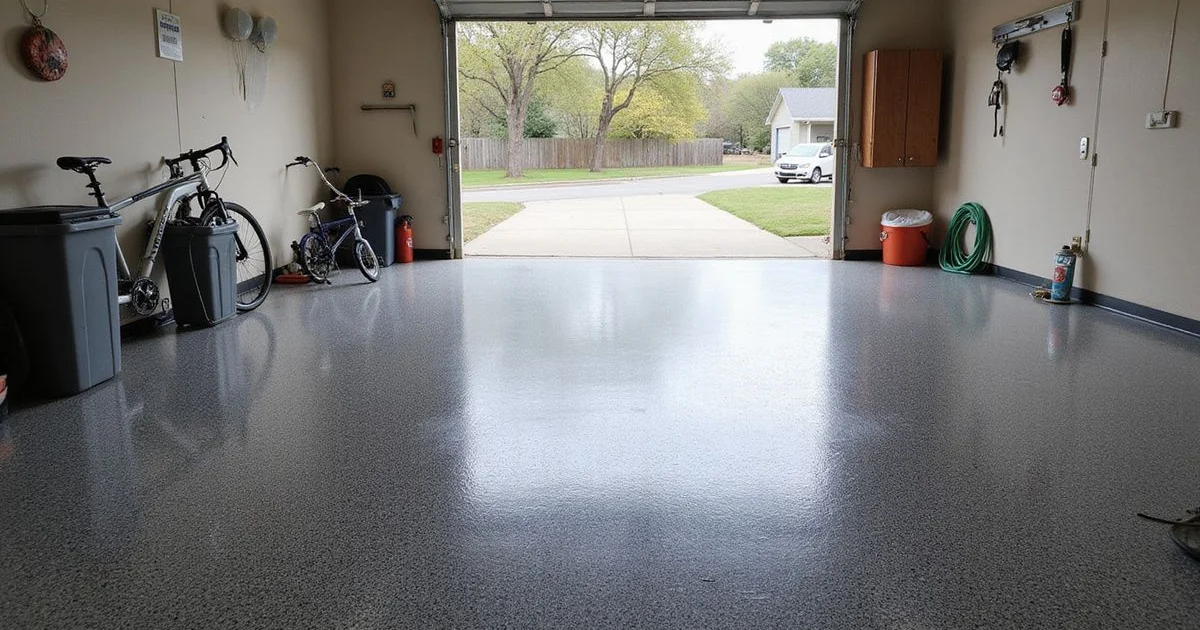
Why garages are a coating job, not a polishing job
We are a polishing specialist, and garages are one of the places we routinely recommend a coating instead. The reasons are practical: garage slabs see vehicle fluids, road salt in the rare Texas winter event, hot tyres, dropped tools, and grit tracked in from outside. A non-porous coating handles that combination better than bare or polished concrete.
Garage coatings sit within our epoxy flooring work, and this guide covers what a proper system involves.
How a flake system is built
A typical multi-layer garage system:
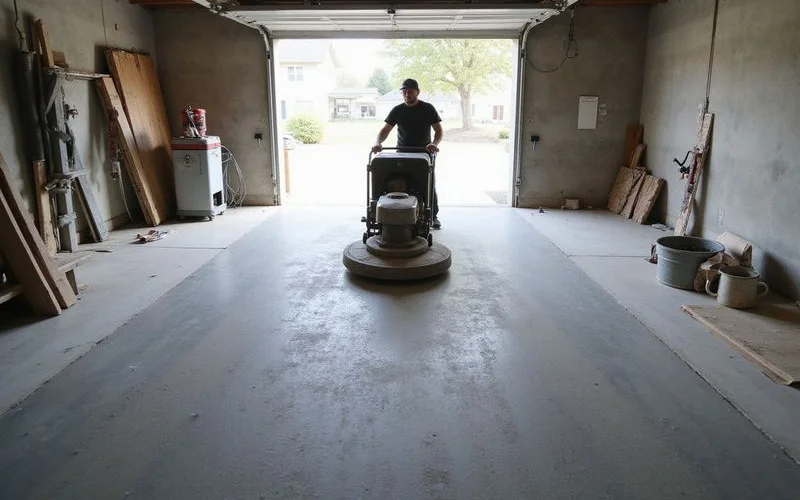
- Mechanical preparation. The slab is ground to the required concrete surface profile with dust extraction running. Cracks, pits, and spalls are repaired.
- Primer or base coat. Applied to the prepared concrete. Where moisture readings call for it, a mitigating primer is used.
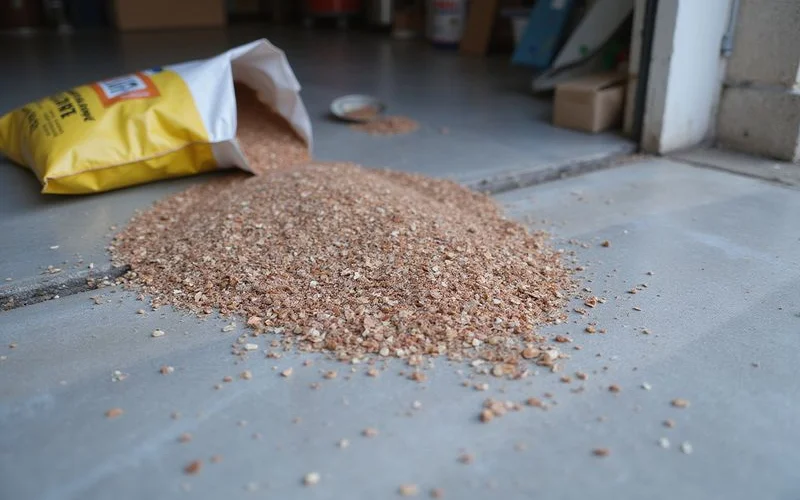
- Flake broadcast. Vinyl chips are broadcast into the wet base — to refusal for full coverage, or partially for a lighter pattern.
- Scrape and vacuum. Excess flake is removed and the surface knocked back so the topcoat lies flat.
- Topcoat. One or two coats of polyaspartic or urethane, which is where most of the wear and UV resistance lives.
The flake is not purely decorative. It adds a subtle texture that improves traction, and it hides dust and minor marks far better than a solid colour.
Epoxy and polyaspartic: the actual difference
| Property | Epoxy | Polyaspartic |
|---|---|---|
| Typical role | Base coat, bonds to concrete | Topcoat, wear layer |
| Cure speed | Slower, hours between coats | Fast, can allow same-day recoat |
| UV stability | Many resins amber in sunlight | UV stable |
| Abrasion resistance | Good | Better |
| Application window | Forgiving | Short — needs experienced application |
Most quality systems use both: epoxy for adhesion and body, polyaspartic for the surface you actually walk and drive on. “Polyaspartic floor” as a marketing term usually still means an epoxy or primer base underneath.
Preparation, and why it is not optional
Every failed garage coating we are called to look at failed at the bond line. The usual causes:
- Acid etching instead of mechanical grinding
- Coating applied over an existing sealer that was never removed
- Moisture in the slab not tested before application
- Oil contamination not fully removed from the parking area
- Product applied outside its temperature window
Grinding is noisy, dusty work that takes a day on a typical garage. It is also the step that determines whether the floor is still bonded in five years.
Hot tyre pickup, explained
A tyre heats on the road, then cools and contracts while parked. If the coating’s adhesion is weaker than that grip, the tyre lifts it. Correct preparation and an appropriate topcoat prevent it; a thin DIY kit over an etched slab frequently does not.
What to expect in an Austin garage
Heat. A closed garage in July gets hot. Application timing and product selection account for that.
Sunlight at the door line. The first few feet inside the door see direct sun. A UV-stable topcoat keeps that strip from ambering differently to the rest.
Slab condition. Many garage slabs have control joints, cracks from soil movement, and a fall toward the door. Cracks are repaired before coating; the fall stays, because it is there for drainage.
Cure before use. Foot traffic and vehicle traffic have different cure times, and driving on a floor too early is a common way to ruin a good installation. We state both in the scope.
Big-box kits versus an installed system
The kits sold for weekend application are not the same product category, and the difference is worth understanding before comparing prices.
Preparation. Kits typically supply an acid etch. Etching roughens the surface chemically but does not produce the mechanical profile a durable coating needs, and it leaves residue that must be neutralised and rinsed. Installed systems grind.
Solids content. Many kits are water-based with low solids, so the dry film left behind is thin. An installed 100% solids epoxy leaves a substantially thicker, tougher layer.
Topcoat. Kits often finish at the base coat with a light flake scatter. Wear resistance, chemical resistance, and UV stability all live in the topcoat, which is where the money goes in a professional system.
Cure discipline. Driving on a floor before it has cured is one of the most common ways a good installation is ruined, and a kit’s instructions are easy to rush on a weekend.
None of that makes kits worthless — for a lightly used garage on a modest budget, one can look fine for a few years. It does mean that comparing a kit price against an installed quote is comparing two different products.
Care and realistic lifespan
Sweep or dust mop regularly, since grit is the main abrasive. Clean with a mild cleaner, not a harsh solvent. Use a mat under the parking position if you regularly arrive with hot tyres after a long drive. Wipe fluid spills rather than leaving them.
Lifespan depends on the system, the preparation, and the use. A well-prepared, properly topcoated garage floor in normal residential service lasts a long time; the same product over a poorly prepared slab may not last two summers. We will tell you what specifically would shorten the life of the system we propose, rather than quoting a number that applies to every garage.
For the wider picture on coating systems and their limits, see epoxy flooring uses and care.